

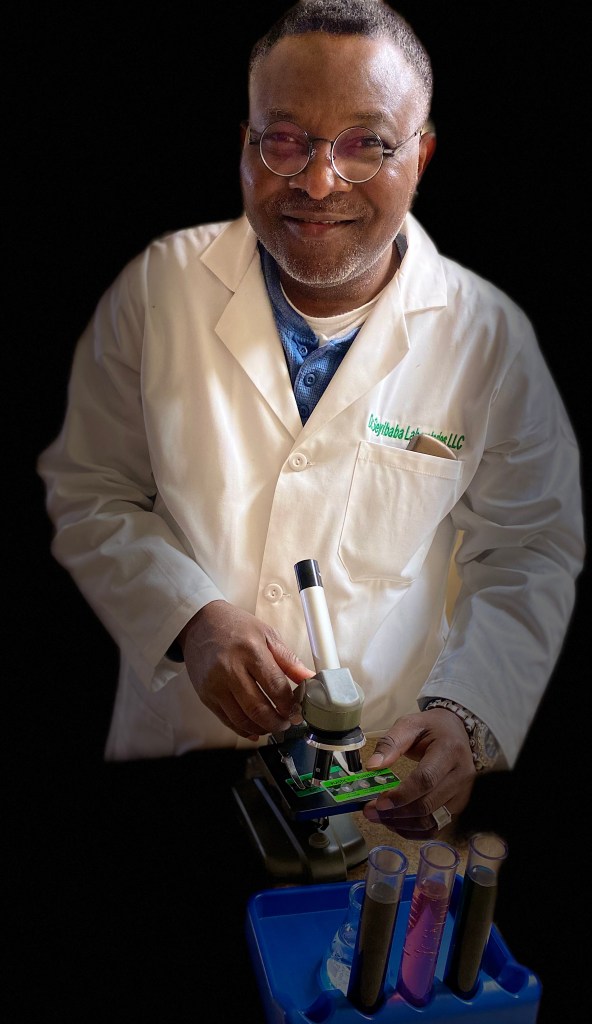
Dr. Oluseyi Ilesanmi (AKA Dr. Seyibaba) is a microbiologist, educator, health care administrator and a fourth-generation integrative health care specialist. In 1990, Dr. Seyibaba and two other scientists were the first to observe and document alcohol tolerance in osmophilic yeast at the microbiology laboratory of the university of Ibadan.
As an educator, Dr Seyibaba has written and taught many educational courses including neuro-science and education: An interdisciplinary approach to learning, Multiple Intelligences:Understanding A Child’s Learning Profile, Germs and Hygiene:Avoiding the Spread of Disease in a Learning Environment and many more.
As a health care administrator, he worked as an implementation specialist for a health care consulting firm.
As an integrative health care specialist, Dr. Seyibaba knows the importance of phytochemicals to our well being and has extensive knowledge in virology, bacteriology, mycology, immunology, biochemistry,
Microbial pathogenesis. and pharmacology.
Virology is the study of viruses, and they are the smallest micro-organisms that cannot be seen by the naked eye. When observed under the microscope, they are unicellular organisms with single-strand ribonucleic acid (RNA). Aside from physical trauma, certain environmental factors like pollution, radioactive emission, etc, and oxidative free radical molecules.
Viruses are the causative agents of many inflammatory disease conditions including many lungs and respiratory tracts infections like flu, covid-19 etc, skin infections such as Chicken pox, measles , herpes etc. Many plants phytonutrients including flavonoids , carotenoids, lignans, etc, can help in enhancing the well being of various human body systems.
Bacteriology is simply the study of bacteria. Just like virus, bacteria can not be seen with the naked eyes but when observed under the microscope bacteria have double strand molecules called Deoxyribonuclic acid (DNA) in their cell. They are single cell micro-organisms and they are often times characterized as gram positive or gram negative organisms based on the type of disease they cause. Bacteria are also the causative agent of many disease conditions including mouth infection like gingivitis, bad breath etc.
Reproductive system diseases like gonorrhea, syphilis, etc.
Digestive system diseases like dysentery , ulcer etc. and many others.
Many plants phytochemicals are also able to help ehance the health of this body systems.
Mycology is the study of fungi and they are mostly spore forming organisms. They are the causative agent of many integumentary system disease in humans and plants. For instance, Candida albicans, a spore forming yeast is the causative agent of candidiasis in humans causes candida in human (most women contact this disease through toilet sits). Other types of fungi diseases in humans include finger and toe nails infection, athletes foot infection , dandruff and many other disease. Also, osmophlic yeast (a fungus) is the major causative agent in the spoilage of most fruits. This yeast can be cultivated and germinated on wort broth in the laboratories and various phytochemicals can be used to perform sensitivities test on it.
Immunology is the study of the immune system and is a very important branch of the medical and biological sciences. The immune system protects us from infection through various lines of defense. If the immune system is not functioning as it should, it can result in disease such as auto-immune allergies, Acquired Immunodeficiency Syndrome(AIDS) etc. Many phytonutrients, vitamins and minerals can be used to enhance the health of the immune system.
Biochemistry is the application of chemistry to the study of biological processes at the cellular and molecular level. Biochemistry is both life science and chemical science, it explores the biochemical interaction of living organisms and the molecular basis for the changes occurring in living cells. For instance, the synthesis of fat to produce energy and the break down of carbohydrates into glucose for energy use are both biochemical processes. Our exceptional understanding of all these various biochemical interaction and or processes help us produce high quality Dr. Seyibaba herbal products.
Microbial pathogenesis is the ability of microbes or their components to cause infections in a host after developing a complex mode of interaction from both host and pathogens. Since Dr. Seyibaba understands the process of disease formation in humans, his products are designed and formulated to enhance the health of various body systems.
Pharmacology is a branch of medicine, biology and pharmaceuticals sciences concerned with drugs or medication where a drug maybe defined as any synthetic, natural or endogenous molecules which exert a biochemical or physiological effect on cell, tissues, organs or organisms. Using the latest advance extraction process, Dr. Seyibaba’s products maintain the natural state and potency of phytonutrients.
 Dr. Seyibaba Marketplace